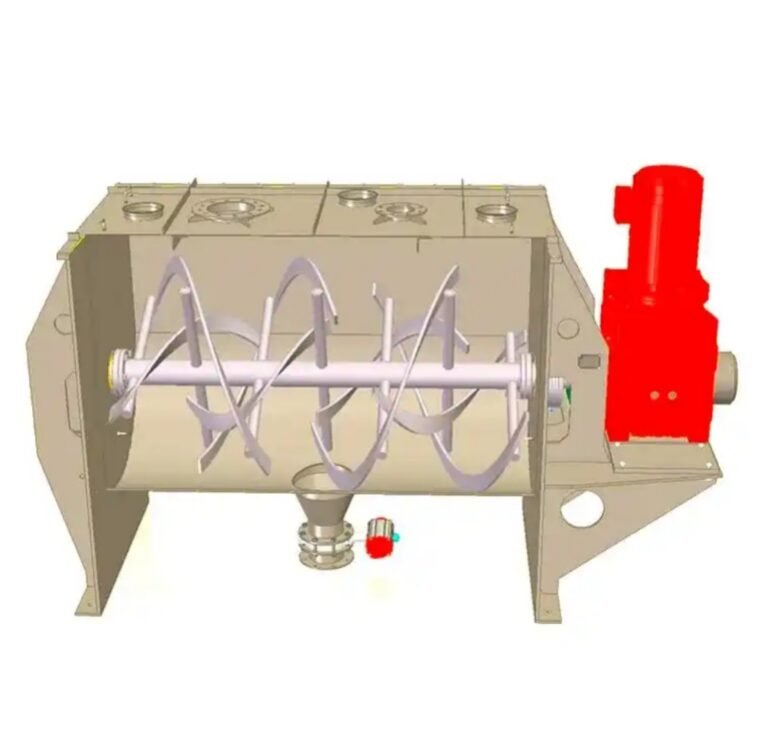
A V-blender is one of the most reliable tools for mixing dry powders and granules — and one of the most misused. Overload it, and mixing time doubles. Skip the cleaning step, and you risk cross-contamination. Ignore the pre-run check, and a loose bolt can shut down your line for a day.
This guide walks through the correct operating procedure for a 300L V-type blender, based on how food and pharmaceutical plants actually run them on the production floor.
The V-shaped vessel rotates around a horizontal axis. As it turns, material is repeatedly split at the bottom of the V and recombined at the top — a gentle convection action that produces a highly uniform blend without degrading fragile particles.
Because there are no internal blades or agitators, there are no dead spots. That’s why V-blenders are the standard choice for pharma, food additives, and fine chemicals where cleanability and batch integrity matter.
2. Before You Start: Pre-Run Check
Never skip this. Five minutes of inspection prevents hours of downtime.
- Discharge valve closed and locked — confirm the butterfly or ball valve at the bottom is fully shut before loading
- Lid and access ports secured — both charging ports must be tightly closed; a loose lid will leak powder and can damage the drive
- Rotation direction — run a 10-second jog to confirm the drum rotates in the correct direction (check the arrow on the frame)
- Emergency stop accessible — the E-stop button must be within arm’s reach of the operator
- Grounding connected — especially important for fine powders with static risk
3. Loading the Right Way
Fill level is the single biggest factor in blend quality.
- Maximum load: 50–60% of total volume. For a 300L blender, that’s roughly 150–180 liters of bulk material. Overfilling leaves no headspace for the material to tumble, and mixing becomes ineffective.
- Load sequence: add the larger-volume component first, then the minor ingredients on top. This helps the minor components disperse evenly as the drum rotates.
- Use the charging port, not the discharge valve. Loading through the bottom valve risks damaging the seal and introduces contamination points.
4. Mixing Time and Speed
| Parameter | Typical Setting |
|---|---|
| Rotation speed | 15–25 RPM (fixed on most models) |
| Mixing time | 10–20 minutes for most powders |
| Cohesive / sticky materials | 20–30 minutes |
| Free-flowing granules | 5–10 minutes |
Pro tip: Run a validation blend for each new formula. Mix for 10 minutes, sample, then mix another 5 minutes and sample again. When uniformity stops improving, you’ve found your optimal time — no need to run longer.
5. Discharging
- Stop the blender with the discharge valve pointing downward. Most units have a positioning mark on the frame.
- Place the collection container or liner under the valve before opening.
- Open the valve slowly. A sudden full-open can cause powder dusting and material loss.
- Rotate the drum by jog mode (in short pulses) if material doesn’t flow freely — this helps release any material resting in the V corners.
- 6. Cleaning Between Batches
This is where V-blenders earn their advantage — but only if done right.
- Brush out residual powder with a soft nylon brush after discharge
- Wipe contact surfaces with a clean, lint-free cloth; for food/pharma, use isopropyl alcohol or approved cleaning agent
- Inspect the discharge valve seal and charging port gaskets — replace if cracked or compressed
- Air dry fully before the next batch; moisture causes caking and bacterial risk
- Document the cleaning in your batch record if operating under GMP
For full disassembly cleaning, the V-drum can usually be removed from the frame after loosening the flange bolts — refer to your model’s manual for the exact procedure.
7. Routine Maintenance Schedule
| Frequency | Task |
|---|---|
| Every batch | Inspect valve seal, check lid gaskets, wipe down exterior |
| Weekly | Check drive belt tension, lubricate bearings (food-grade grease), inspect electrical connections |
| Monthly | Check drum mounting bolts, verify grounding, test E-stop function |
| Quarterly | Inspect gearbox oil level, check for unusual noise or vibration during operation |
8. Safety Rules
- Never open the charging lid while the drum is rotating — material can eject, and the rotating vessel is a pinch hazard
- Never exceed the rated load — overloading strains the motor, drive, and bearings
- Lockout / tagout before any maintenance or disassembly
- Keep hands and tools clear of the rotating drum and drive assembly
- Use dust extraction when handling fine or hazardous powders
Final Note
A V-blender is a simple machine, but consistent results come from disciplined operation: correct fill level, validated mix time, thorough cleaning, and regular maintenance. Skip any of these, and you’ll see it in your product — uneven batches, cross-contamination, or unexpected breakdowns.