How to Build an Efficient Powder Packaging Line: Step-by-Step Layout Guide
Building a powder packaging line is much more than connecting individual machines together. A poorly planned line causes bottlenecked stations, unbalanced output, excessive material waste, and expensive rework later. Many manufacturers focus only on the filling machine and underestimate the impact of upstream feeding, downstream inspection and end-of-line handling on overall line efficiency.
Whether you are setting up a new production line or upgrading an existing one, this guide walks you through each process stage, explains key selection criteria, and shares proven layout principles to help you build a balanced, efficient and scalable powder packaging line.
Start with Core Parameters Before Selecting Any Machine
Good line design starts with clear definitions, not equipment catalogs. Confirm these four parameters first:
- Powder material properties Flowability, bulk density, dustiness, abrasiveness and hygroscopicity determine which feeding and filling technology will work reliably.
- Target production output Define your real required output in finished packs per minute, not just daily or annual volume. Account for changeover time, downtime and efficiency loss.
- Packaging specifications Container type (bag, jar, can, sachet), fill weight range, closure type and labeling requirements define the equipment configuration at each stage.
- Regulatory and compliance requirements Food, pharmaceutical and chemical industries have different standards for hygiene, material contact, accuracy and traceability.
Stage 1: Upstream Material Handling & Feeding
The upstream section delivers consistent powder supply to the filling station. It is often the most overlooked source of line instability.
Key equipment options:
- Screw conveyor: For general powder transfer over short to medium distances. Good for most food and chemical powders.
- Vacuum conveyor: For dust-tight transfer of fine, high-value or toxic powders. Minimizes material loss and workshop contamination.
- Buffer hopper: Provides consistent material head pressure and decouples filling from upstream production. Critical for steady filling accuracy.
Design principles:
- Match conveyor capacity to at least 120% of filling machine throughput to avoid starving the filler.
- Minimize transfer height and sharp bends to reduce product degradation and dust generation.
- Include a level sensor in the buffer hopper to control upstream feed automatically.
Stage 2: Core Filling & Weighing Station
The filling station is the heart of the line, and its performance defines overall line capacity and accuracy.
Selection guidelines:
- Volumetric cup filler: For free-flowing granular products, high speed, moderate accuracy requirements.
- Servo auger filler: For fine, fluffy or cohesive powders, high accuracy requirements, multi-SKU production.
- Net weight gravimetric filler: For high-value and regulated products where weight accuracy is critical.
Layout tips:
- Allow enough space around the filler for operator access, material refill and maintenance.
- Position dust extraction directly at the filling point, not just general workshop ventilation.
- Place the filler at the center of the line layout to minimize upstream and downstream transfer distances.
Stage 3: Mid-Line Closing, Sealing & Inspection
After filling, containers move to sealing and quality control stations. These stations must match filler speed to avoid creating bottlenecks.
Common station configurations:
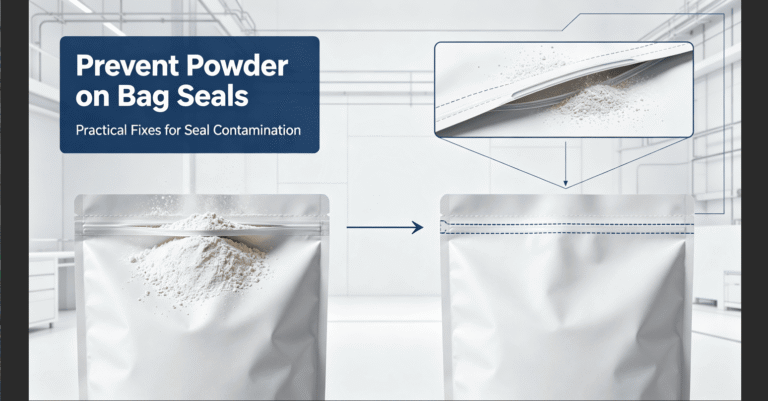
- Bag clamping & heat sealing: For open-mouth bags. Include bag top cleaning before sealing to prevent powder contamination on the seal.
- Capping / vacuum capping: For jars and bottles. Match capper speed to filler output.
- Check weigher: 100% weight inspection with automatic rejection. Essential for regulated and high-value products.
- Metal detector: For food and pharmaceutical lines to detect product contamination.
Design principles:
- Every downstream station must be capable of slightly higher speed than the filler to avoid backpressure and line stoppage.
- Place rejection bins immediately after inspection stations with clear access for operator removal.
- Include product accumulation between stations to absorb minor speed variations.
Stage 4: End-of-Line: Labeling, Case Packing & Palletizing
End-of-line automation is often added as an afterthought, but it has a major impact on labor cost and overall line output.
Equipment options by scale:
- Semi-automatic labeling and manual packing: For low-volume, multi-SKU production.
- Automatic labeler + case erector + case packer: For medium-volume continuous production.
- Robotic palletizing: For high-volume lines with heavy cases or multi-shift operation.
Scalability advice:
If you expect volume growth, design the layout with space for future end-of-line automation. It is much cheaper to add equipment later than to rearrange a fully built line.
Line Layout Best Practices to Avoid Common Bottlenecks
- Follow straight-line product flow Arrange stations in a straight line from infeed to outfeed whenever possible. Avoid U-turns and cross flow that create congestion and safety issues.
- Balance station capacities Each station should be rated for 10–20% higher output than the target line speed. This prevents the slowest station from limiting the whole line.
- Allow maintenance and operator access Leave at least 80–100cm clearance on the service side of each machine. Tight layouts cause longer downtime and poor maintenance.
- Plan for utilities Position machines close to required power, compressed air and dust extraction connections. Long utility runs add cost and reduce performance.
- Build in scalability Choose modular equipment and leave floor space for future upgrades. A line that cannot grow with production becomes a stranded investment.
Standard Line Configurations by Capacity
Low-Volume / Pilot Line (10–30 packs/min)
- Manual or semi-automatic feeding
- Single-head auger or cup filler
- Manual or semi-automatic sealing
- Manual check weighing
- Manual packing and palletizing
- Best for: small batches, product development, multi-SKU low-volume production
Medium-Volume Production Line (30–80 packs/min)
- Automatic screw or vacuum conveyor feeding
- Single-head servo auger filler
- Automatic sealing / capping
- In-line check weigher with rejection
- Automatic labeler
- Semi-automatic case packing
- Best for: most food, nutraceutical and medium-scale chemical production
High-Volume Mass Production Line (80+ packs/min)
- Continuous automated upstream conveying with buffer storage
- Multi-head filling system
- High-speed rotary capper / sealer
- Full inspection: check weigher + metal detector + vision inspection
- Automatic case erecting, packing and sealing
- Robotic palletizing
- Best for: large food, pharmaceutical and industrial powder mass production
Final Thoughts
An efficient powder packaging line is not just a collection of good machines. It is a balanced system where each station matches the others in speed, reliability and function.
Start planning from your product and production requirements, work through each stage systematically, and prioritize balance and scalability over maximum speed or lowest initial cost. This approach will deliver a line that runs reliably, produces consistent quality, and grows with your business.
If you are planning a new powder packaging line or upgrading an existing one, our engineering team can review your requirements, propose an optimized layout, and specify equipment matched to your exact powder and production targets. Contact us today for a free line design consultation.