Volumetric vs Screw vs Net Weigh Powder Filler: Which Is Best for Your Line?
Many food factory managers buy a powder filler based only on price and rated capacity, only to discover it is a poor match for their actual product. Some fight constant dust and drifting accuracy with fine cocoa powder. Others find volumetric units swing wildly with every batch of protein powder.
Picking the wrong filling technology causes more downtime and waste than picking the wrong brand. This guide breaks down the three most common food powder filling systems — volumetric cup, auger screw and net weigh — how they work, which materials they fit, and how to choose the right one for your production.
Three Core Filling Technologies: How They Work
Each technology works on a different principle. No single type is best at everything — each has strengths, weaknesses and ideal applications.
1. Volumetric Cup Filler
Volumetric fillers dose by fixed volume. A rotating cup disk cuts and delivers a set volume of powder into the package.
- Advantages: Very high speed, simple mechanical design, low purchase cost, easy maintenance, few moving parts.
- Limitations: Accuracy is directly affected by bulk density changes. Poor performance with fine, dusty powders; high dust emission. Cannot adjust easily for density variation between batches.
- Best for: Uniform granules, free-flowing powders with stable density — granulated sugar, salt, granular spice, instant drink granules.
- Not recommended for: Fine powders, light powders, materials with batch-to-batch density variation.
Field pitfall: This is the most commonly misapplied filler. Many buyers choose it for low price, then struggle with ±3%+ error and heavy dust when running fine spice or cocoa powder.
2. Auger Screw Filler
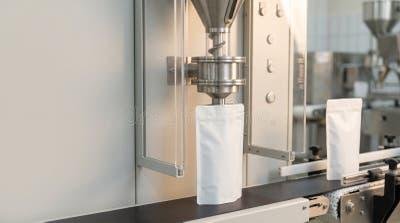
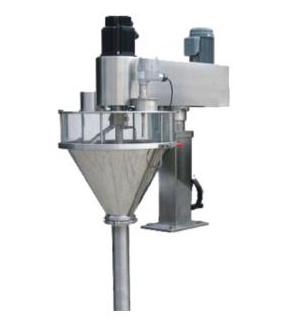
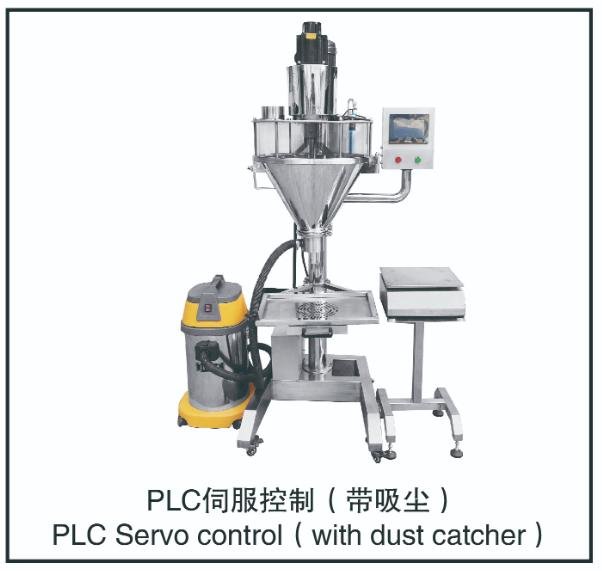
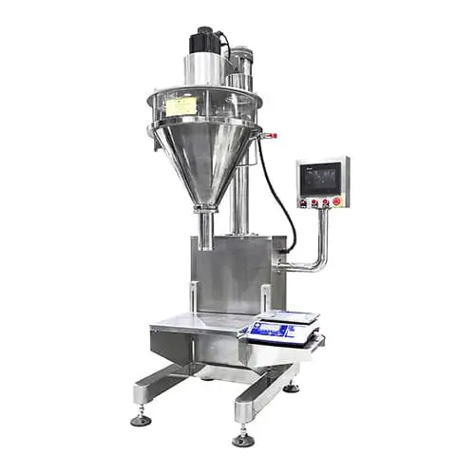
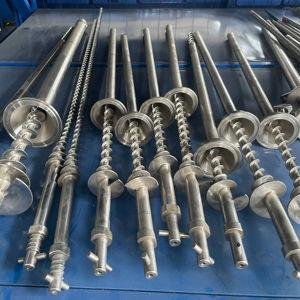
Screw fillers use positive-displacement auger rotation. A servo motor rotates the screw an exact number of turns to deliver a consistent volume.
- Advantages: Good and consistent accuracy, excellent dust control with enclosed structure, wide versatility across powder types, works well with fine and ultra-fine powders.
- Limitations: Slower than volumetric cup fillers. Optimal performance requires matched screw geometry for each material type.
- Best for: Fine powders, light powders and most standard food powder products — cocoa, coffee, milk powder, protein powder, spice, flour, food additives.
- Not recommended for: Very large granules or extremely high-speed single-product lines where volumetric is sufficient.
3. Net Weigh Filler
Net weigh fillers dose by actual weight. Powder is discharged into a weighing hopper, and the feeder stops automatically once the target weight is reached.
- Advantages: Highest possible accuracy, completely unaffected by bulk density changes. Very reliable for high-value products.
- Limitations: Slowest of the three types. Higher purchase cost and more complex mechanics. Not ideal for very fine, dusty powders due to weighing sensitivity.
- Best for: High-value powders, large pack sizes, products with highly variable density — premium nutritional powders, specialty ingredients, 5kg–25kg bulk packs.
- Not recommended for: High-volume small packs, ultra-fine dusty powders.
Side-by-Side Comparison Table
| Parameter | Volumetric Cup | Auger Screw | Net Weigh |
|---|---|---|---|
| Dosing principle | Fixed volume | Positive displacement screw | Gravimetric weighing |
| Typical production accuracy | ±1% to ±3% | ±0.3% to ±1% | ±0.1% to ±0.5% |
| Typical speed range | 30–150 packs/min | 10–80 packs/min | 5–30 packs/min |
| Best suited material | Uniform granules, stable density | Fine / standard food powders | High-value / variable density |
| Dust control | Poor | Excellent | Moderate |
| Purchase cost | Low | Medium | High |
| Maintenance cost | Low | Medium | Medium-high |
How to Choose the Right Technology for Your Factory
Work through these five steps in order, and you will avoid 90% of common mis-selection mistakes.
1. Start with your material properties
This is the single most important factor.
- Free-flowing granules with stable density → volumetric cup will give you the best speed and lowest cost.
- Fine, light or dusty powder → auger screw is almost always the correct choice.
- Very high value or highly variable density → net weigh delivers the lowest total waste cost.
2. Match to your accuracy requirements
- If you only need rough dosing and product is low value, volumetric is sufficient.
- If you face regulatory weight inspections or product is moderately valuable, servo screw is the standard.
- If product is very high value and overfill cost is extreme, net weigh will pay for itself in reduced waste.
3. Align with your output target
- Very high volume, single product → volumetric
- Medium to high volume, multi-product → auger screw
- Low volume, high value → net weigh
4. Factor in changeover frequency
If you run many SKUs or frequent product changes, screw fillers offer the best balance of versatility and changeover speed. Volumetric cups also change over quickly but only for similar materials.
5. Calculate total cost, not just purchase price
The cheapest machine often costs the most over 5 years. Include material waste, downtime, extra labor and rework cost in your calculation. A more expensive machine that cuts waste by 2% can pay for itself very quickly with expensive raw materials.
【7 Ways to Improve Powder Filling Accuracy】
Real Project Case: Coffee Powder Factory Filler Replacement
Client Background
A specialty coffee powder producer in Yunnan, China, producing 250g and 500g stand-up pouches. They initially purchased two volumetric cup fillers to save cost. Core pain points: filling error fluctuated between ±2.5% and ±3.5%; heavy airborne dust in the production area; raw material waste was costing them over ¥500,000 per year; failed workplace dust inspection twice.
Core Requirements
- Stabilize filling accuracy within ±0.5% to reduce waste
- Control dust emission to meet workplace standards
- Maintain at least the same production output
- Support quick changeover between roast levels
Our Solution
Replaced both volumetric fillers with 30L servo-driven auger screw fillers, fitted with fine-powder optimized screws and integrated dust extraction ports connected to the plant dust collection system. Custom adjustments:
- Wide-pitch shallow-flute screws for roasted coffee powder
- Servo drive with recipe memory for different roast profiles
- Enclosed transfer path to minimize dust
Results
- Accuracy: stabilized at ±0.3% to ±0.4% consistently
- Material waste: reduced from 2.7% to 0.4%, saving approximately ¥520,000 per year in raw coffee powder
- Dust control: workshop dust levels reduced by 85%, passed regulatory inspection on first attempt
- Output: maintained 45 packs per minute per machine, matching the previous volumetric speed
Client Feedback
“We bought volumetric because they were cheaper. We didn’t realize how much money we were just throwing away as overfill, not to mention the dust. The screw fillers paid for themselves in raw material savings alone in about 11 months. We should have done this years ago.” — Plant Manager Liu (discretionary)
Frequently Asked Questions
Which type of powder filler is the most accurate?
Net weigh fillers are the most accurate in principle, since they measure by actual weight and are unaffected by density. For fine powder production, however, servo auger screw fillers deliver excellent real-world accuracy of ±0.3% to ±0.5% at much higher speeds.
Is a screw filler always better than a volumetric filler?
No. For uniform, stable, free-flowing granules like salt or granulated sugar, volumetric cup fillers are faster, simpler and cheaper. They are only a bad choice for fine powders and materials with variable density.
When should I use a net weigh filler?
Use a net weigh filler when: product is very high value, bulk density varies greatly between batches, pack size is large (5kg+), or absolute weight accuracy is required for regulatory or commercial reasons.
Can I use one filler for all my different powder products?
It depends on how different they are. Similar powders with close density can run on the same screw filler with parameter changes. Very different materials (fine powder vs granules) will require screw changes — or in some cases, different filling technologies entirely.
Summary
There is no universal best powder filler. The right choice depends on your material, your accuracy needs, your output volume and your product value. Volumetric for speed and low cost with stable granules. Auger screw for the best all-around performance with most food powders. Net weigh for maximum accuracy with high-value products.
If you have determined an auger screw filler is right for your operation, use our screw metering machine selection guide to size it correctly. For tips on optimizing performance, see our guide to improving powder filling accuracy.
Uniflow Packaging Machinery | Food-grade powder filling equipment, custom matched to your product. Follow our 【LinkedIn】 for more factory case studies, or subscribe to our 【YouTube channel】 for side-by-side filler trial videos. Contact our engineering team for a free application assessment and recommendation.