How Does a Food Powder Packaging Machine Work? A Complete Buyer’s Guide
For food powder manufacturers, manual packing has long been a source of persistent headaches: inconsistent fill weights, excessive material waste, dust contamination, low output, and difficulty meeting food safety compliance. As production scales up, an automated food powder packaging machine becomes not just an upgrade, but a necessity to stabilize quality, reduce costs, and pass regulatory audits.
In this guide, we break down the full working process of a powder packaging line, compare the three most common filling technologies, and outline the core metrics you need to evaluate before purchasing. By the end, you will have a clear framework to match equipment to your product, capacity, and compliance requirements.
Why Automated Food Powder Packaging Is Critical for Production
Before diving into how machines work, it is important to clarify the core value automation delivers for powder production:
- Consistent batch quality: Eliminates human error in fill weights, reducing rejected batches and customer complaints about net content deviation.
- Food safety & hygiene: Minimizes manual contact with products; fully enclosed systems reduce cross-contamination and microbial risks, which is essential for dairy, infant formula, and nutritional powder.
- Higher output & lower labor cost: A single automatic line can replace 5–10 manual packing workers, delivering 2–5x higher output with stable performance.
- Reduced material waste: High-precision metering cuts overfilling waste by 1–3%, which adds up to significant material cost savings over a year of production.
- Dust control: Enclosed conveying and filling structures suppress airborne powder, improving workshop conditions and reducing explosion risks for fine combustible powders.
Step-by-Step Working Process of a Food Powder Packaging Line
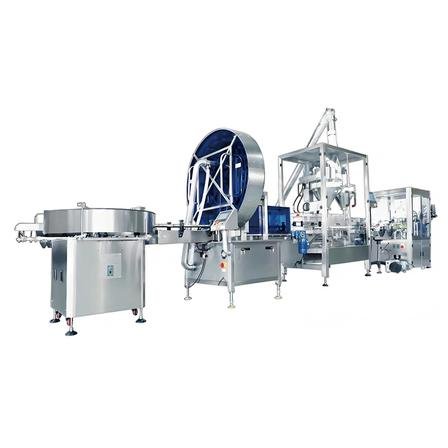
A standard automatic powder packaging line completes the entire process from raw material to finished sealed product in 6 sequential stages:
1. Raw Material Conveying & Feeding
Powder is transported from bulk storage silos or bins to the packaging machine hopper through a closed conveying system — usually a vacuum conveyor or screw feeder. This closed transfer prevents dust escape and external contamination. For cohesive or bridging-prone powders, the hopper is fitted with a vertical agitator to keep material flowing smoothly.
2. Metering & Filling
This is the core stage that determines accuracy and efficiency. The metering unit discharges a fixed volume or weight of powder into pre-formed bags, pouches, or bottles. The choice of metering technology is the most important decision for powder packaging — we compare the three main types in the next section.
3. Bag / Container Forming & Feeding
- For vertical form-fill-seal (VFFS) lines: a roll of packaging film is pulled, formed into a continuous tube, and sealed at the bottom to create individual pouches.
- For bottle/jar filling lines: empty containers are sorted by a bottle unscrambler and fed into the filling conveyor at consistent intervals.
4. Sealing & Shaping
After filling, the package passes through a sealing station. For powder products, sealing usually includes a degassing function to expel trapped air inside the pouch, which prevents powder agglomeration during shelf life and ensures tight, leak-proof seals.
5. Coding & Quality Inspection
A date coder prints production date, batch number and expiration date on each package. A checkweigher then automatically rejects under-filled or over-filled packages, ensuring every unit meets declared net content requirements.
6. Finished Product Discharge
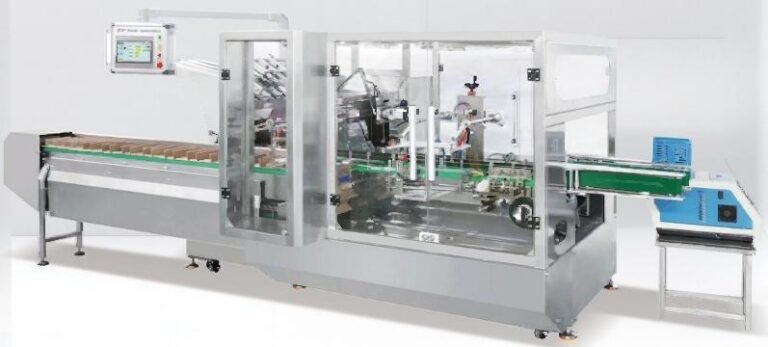
Qualified packages are discharged onto the output conveyor, ready for secondary packaging such as cartoning or palletizing.
3 Main Powder Filling Technologies: Pros, Cons & Best Use Cases
Filling technology defines 80% of a powder packaging machine’s performance. Below is a side-by-side comparison of the three most widely used methods in the food industry:
| Filling Method | Working Principle | Typical Accuracy | Speed | Best For | Key Drawbacks |
|---|---|---|---|---|---|
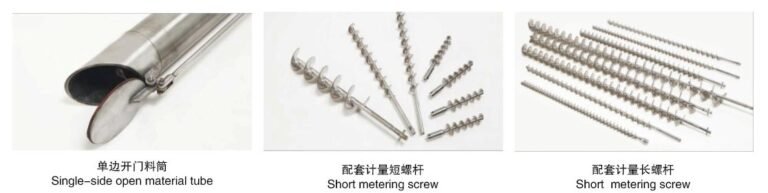
| Auger / Screw Filling | Controls discharge volume by the number of screw rotations | ±0.2% ~ ±1% | 10–80 bags/min | Fine powder, ultra-fine powder, slightly cohesive powder | Higher initial cost; requires calibration for density changes |
| Volumetric Cup Filling | Fills fixed-volume cups and drops material into packages | ±1% ~ ±3% | 30–120 bags/min | Free-flowing granular powder, uniform particles | Poor accuracy for fine or density-varying materials |
| Net Weigh Filling | Weighs material directly in the weighing hopper before discharge | ±0.1% ~ ±0.5% | 5–30 bags/min | High-value powder, large package sizes | Slow speed; higher cost; not ideal for very fine dust |
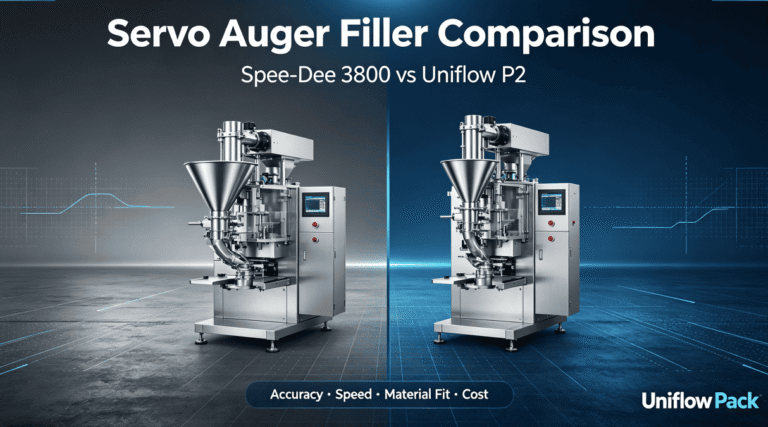
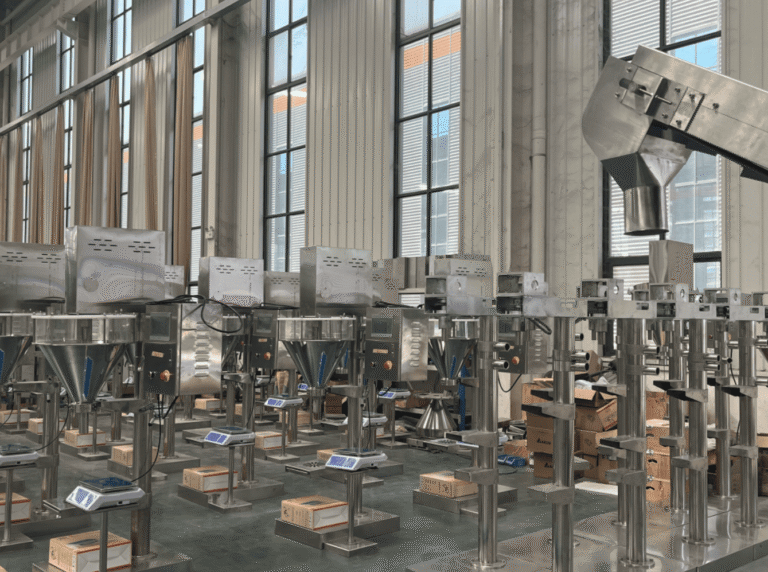
For most food powder applications — from milk powder and spices to flour and protein powder — auger screw filling is the industry standard because it balances accuracy, dust control, versatility and speed.
6 Key Metrics to Evaluate Before Buying
Not all powder packaging machines are built the same. Use these 6 criteria to compare suppliers and avoid costly mismatches:
1. Filling Accuracy
Accuracy is usually stated as ±X% or ±X grams. Always verify accuracy at your actual package size and with your actual product — advertised accuracy is often measured under ideal conditions with free-flowing material. For most food powder, acceptable accuracy ranges from ±0.3% to ±1% depending on pack size.
2. Production Capacity
Capacity is rated in bags per minute (BPM) or bottles per minute (BPM). Note that rated speed is the maximum theoretical speed. For stable long-term operation, plan for 70–80% of the rated capacity to account for feeding pauses, seal time and product changes.
3. Material Compatibility
Match the machine design to your powder characteristics:
- Fine / dusty powder: Requires fully enclosed auger filling with dust suction
- Cohesive / bridging powder: Requires hopper agitator and large-diameter screw
- Hygroscopic powder: Requires heated hopper and sealed structure
4. Food Safety & Compliance
All product-contact parts must be 304 or 316 stainless steel and meet FDA food-contact standards. For EU export, CE certification is mandatory. For GMP or pharmaceutical-grade production, the machine must have a sanitary design with no dead corners, tool-less disassembly and smooth welds.
5. Changeover & Cleaning Efficiency
If you run multiple products or flavors, prioritize machines with quick-disassembly structures, tool-less screw removal and easy-clean hoppers. Fast changeover can reduce downtime between batches by 50% or more.
6. After-Sales Support
For overseas buyers, local service is rare. Verify that the supplier provides:
- Clear installation manuals and video guidance
- Readily available spare parts with reasonable shipping times
- Remote technical support for troubleshooting
Common Industry Applications
Food powder packaging machines are tailored to different industry requirements:
- Dairy & milk powder: High sanitary standards, full stainless steel construction, dust-tight design
- Spices & seasonings: Frequent product changeovers, small pack sizes, high accuracy requirements
- Flour & bakery ingredients: High capacity, large bag sizes (1kg–25kg)
- Nutritional protein powder: High product value, premium sealing, precise filling to minimize waste
- Food additives & ingredients: Micro-dose filling, very high accuracy, contamination prevention
Frequently Asked Questions
What is the best filling method for fine food powder?
For fine and ultra-fine food powders, auger screw filling is the superior choice. Its fully enclosed screw structure effectively controls dust, and the positive-displacement rotation delivers far better accuracy than volumetric methods for pack sizes from 10g up to 5kg.
What is the difference between an auger filler and a volumetric filler?
An auger filler controls output volume by screw rotations, handles a wide range of powders from fine to slightly cohesive, delivers higher accuracy and better dust control. A volumetric (cup) filler uses fixed-volume chambers, runs faster and costs less, but only works well with uniform, free-flowing granular powders and loses accuracy when material density varies.
What certifications are required for food-grade packaging machines?
For export to Western markets, the core certifications are CE (EU safety standard) and FDA food-contact material compliance (US). For supply to GMP-certified food or pharmaceutical facilities, the machine must also meet sanitary design requirements for cleanability and non-contamination.
How much does an automatic powder packaging line cost?
Cost varies widely by configuration: entry-level semi-automatic auger fillers start at a few thousand dollars; fully automatic VFFS powder packaging lines typically range from $10,000 to $50,000+; complete turnkey lines with conveying, filling, sealing and inspection can go higher depending on capacity and customization. Always get a quote based on your exact product, pack size and output target.
Final Thoughts
A well-chosen food powder packaging system balances accuracy, speed, hygiene and total cost — it is not about buying the most advanced machine, but the right machine for your product. Understanding the full workflow and the strengths of each filling technology is the first step to making a sound investment.
If you already know you need high-precision, low-dust powder filling, the screw metering auger filler is the workhorse of the food powder industry. In our next guide, we break down exactly how to select the right auger filler specification, screw size and configuration for your specific product and production volume.
At Uniflow, we design and manufacture food-grade powder filling and packaging systems for food factories worldwide. If you need help sizing the right machine for your production, or want a custom line layout for your factory, contact our engineering team for a free evaluation and proposal.