How to Improve OEE in Powder Packaging Lines: 3 Key Areas & Practical Fixes
For powder manufacturing operations, OEE (Overall Equipment Effectiveness) is the single most important metric for measuring packaging line performance. Yet many factories only track output volume and labor cost, and miss the hidden capacity losses that drag OEE down to 60–70% — or even lower for multi-SKU lines.
Low OEE means you are paying for equipment and labor that is not producing saleable product. It hides excess cost, limits output capacity and makes expansion decisions harder than they need to be. This guide breaks down OEE into its three core components, explains the most common bottlenecks on powder packaging lines, and shares practical, proven improvements you can implement to lift efficiency.
Understanding OEE for Powder Packaging Lines
OEE measures how much of your production time is actually making good product at rated speed. It is calculated from three factors:
- Availability: Percentage of scheduled time the line is actually running
- Performance: How fast the line runs compared to its rated speed
- Quality: Percentage of product that meets specification first time
For powder packaging lines, each of these three areas faces specific, predictable challenges. Targeting each one systematically delivers much better results than generic efficiency initiatives.
1. Improve Availability: Reduce Unplanned & Planned Downtime
Availability losses are the largest and most visible drain on OEE. They include both unplanned breakdowns and planned stops that take longer than necessary.
Common availability losses on powder lines
- Unplanned machine breakdowns from poor maintenance
- Long changeover times between products and pack sizes
- Extended cleaning procedures between batches
- Material feed interruptions and hopper starvation
- Slow startup and adjustment after every stop
Practical fixes
- Implement a structured preventive maintenance program based on actual operating hours, not fixed calendar intervals. Focus on high-wear items like seals, bearings and screw flights.
- Apply SMED (Single-Minute Exchange of Die) principles to changeovers: move preparation work offline, standardize change parts, and create documented one-person changeover procedures.
- Upgrade to tool-free disassembly of product contact parts. This cuts cleaning and changeover time by 30–50% on most auger filling lines.
- Install automated level control in buffer hoppers to eliminate feed interruption downtime.
- Use recipe storage on machine controls to eliminate manual adjustment time after startups and changeovers.
Typical impact
For a typical multi-SKU powder packaging line running 3–4 changeovers per day, reducing changeover time from 45 minutes to 15 minutes alone can add 5–7% to overall OEE.
2. Boost Performance: Eliminate Speed Losses & Minor Stops
Performance losses are often less visible than downtime, but they quietly eat into output capacity. Many lines run well below their rated speed all day long due to small, repeated interruptions.
Common performance losses on powder lines
- Running slower than rated speed to compensate for accuracy or dust issues
- Frequent small stops from product bridging, bag misfeeds and seal issues
- Inconsistent feed rate from bulk density variations
- Unbalanced station speeds causing micro-stops upstream and downstream
- Operator-induced slowdowns from manual adjustments and interventions
Practical fixes
- Match filling screw profile to your specific powder properties. A properly matched screw allows the machine to run at full rated speed while maintaining accuracy.
- Install closed-loop speed control that automatically adjusts feed rate based on actual weight feedback.
- Balance all line stations so each downstream station is rated for 10–20% higher speed than the filler. This eliminates backpressure and micro-stops.
- Address root causes of dust and bridging so you do not have to run the line slower to compensate.
- Optimize operator workflow to reduce manual interventions during production.
Typical impact
Most powder packaging lines run at 70–80% of rated speed during normal production. Fixing speed limiting factors typically delivers an 8–12% gain in output without adding equipment.
3. Raise Quality: Reduce Rejects & Rework
Quality losses reduce OEE directly by producing product that cannot be sold. For powder lines, quality issues also cause downtime for adjustment and cleanup.
Common quality losses on powder lines
- Over-weight and under-weight packs from filling inaccuracy
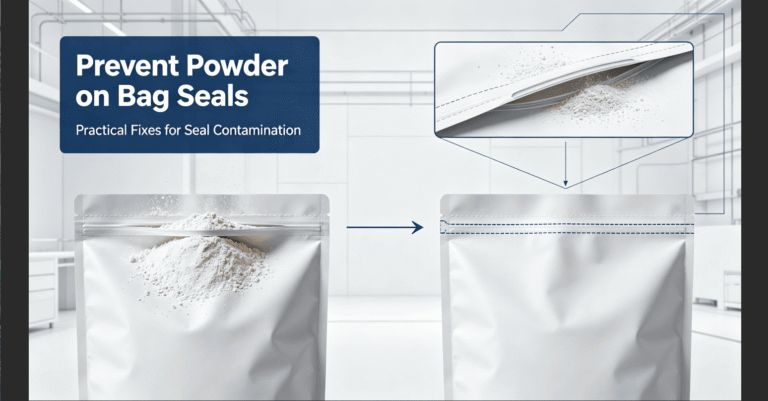
- Sealing defects from powder contamination on seal surfaces
- Rejected batches from inconsistent product weight
- Packaging material waste from misfeeds and misalignment
- Rework of off-spec product that is salvageable
Practical fixes
- Upgrade to gravimetric servo filling with load cell feedback to tighten weight tolerance and reduce both over-fill waste and under-fill rejects.
- Install bag top cleaning before sealing to remove powder from seal areas. This eliminates the single largest cause of seal defects.
- Add an in-line check weigher with automatic rejection to catch every out-of-spec pack before it leaves the line.
- Implement first-piece inspection and short test runs after changeovers to avoid full batches of off-spec product.
- Use consistent packaging material quality. Poor film or bag quality is a surprisingly large source of quality stops.
Typical impact
For lines running at ±0.5% filling accuracy, improving to ±0.2% typically reduces quality-related losses by 50% or more, while also cutting material waste.
Building High OEE Into New Line Design
If you are planning a new packaging line or major upgrade, you can design for high OEE from the start:
- Specify servo-driven machines with recipe storage and quick-change design
- Include buffer hoppers and automated feed control
- Plan the layout for balanced station speeds and minimal transfer points
- Add in-line inspection and feedback control
- Design for fast, tool-free changeovers and easy maintenance
- Choose modular equipment that can be upgraded as production requirements change
Final Thoughts
Low OEE on powder packaging lines is rarely caused by one big problem. It is usually the accumulated effect of many small losses — short stops, slow running, minor rejects, long changeovers — that add up to a huge hidden cost.
You do not need a full line replacement to see major improvement. Start by measuring and identifying your biggest loss area, apply targeted fixes, and track results. Most operations can achieve a 10–15% OEE improvement within 6–12 months with focused action.
If you would like an objective assessment of your powder packaging line OEE, or need equipment recommendations to remove specific efficiency bottlenecks, our engineering team can perform a detailed line audit and propose prioritized improvements. Contact us today to discuss your operation.