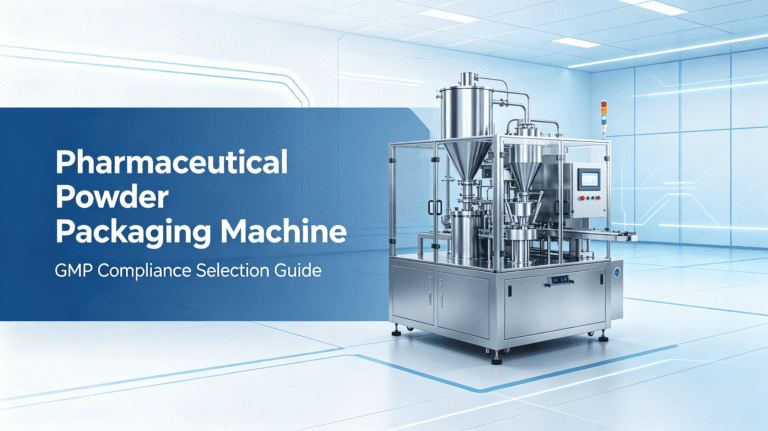
Screw Metering Machine Selection Guide: 30L vs 50L | Material, Accuracy & GMP Compliance
Many food factories choose a screw metering machine based only on hopper size and price. Only after installation do they discover the real issues: inconsistent accuracy, frequent clogging, hours of cleaning between product changeovers, and failures during GMP audits. Retrofit costs often end up higher than the machine itself.
As the core of any powder filling line, a poorly sized auger filler compromises the entire line. This guide breaks down the selection logic across material properties, hopper capacity, mechanical configuration and compliance requirements, with real project data and industry pitfalls we have learned from field experience.
Why Screw Metering Machines Are the Standard for Food Powder Filling
Auger screw fillers account for over 70% of food powder filling applications, because they deliver the best balance across three critical factors:
- Controllable accuracy: Positive-displacement screw rotation delivers consistent discharge volume. For fine and ultra-fine powders, accuracy is far more reliable than volumetric cup fillers, typically holding steady within ±0.5% under normal production conditions.
- Superior dust control: Fully enclosed screw and sealed hopper structure, combined with insert-tube filling, greatly reduces airborne dust in the workshop and meets food hygiene requirements.
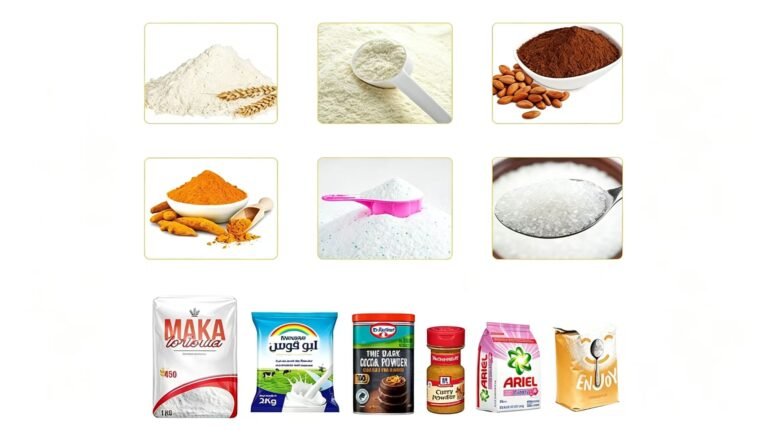
- Broad versatility: From 10g sachets to 25kg bulk bags, and from cocoa powder and milk powder to flour and food additives, the same machine can adapt by changing the screw and adjusting parameters — no need to replace the whole unit.
By comparison: volumetric cup fillers are cheaper but less accurate, and only work well with uniform granules. Net weigh fillers deliver higher accuracy but run slower and cost more. For regular food powder production, screw metering machines offer the best overall value.
Core Selection Criteria: Size Is Not Everything
1. Hopper Capacity: Match Output and Package Size
Bigger is not always better. Oversized hoppers hurt accuracy for small pack sizes; undersized ones limit speed for large packs.
- 30L: The most versatile size. Fits 10g to 5kg packages, single-head output 10–60 bags per minute. Ideal for small-to-medium output and multi-product factories. The standard starting point for most food plants.
- 50L: Fits 500g to 10kg packages, single-head output 20–80 bags per minute. Best for medium-to-high output lines running mostly a single product.
- 100L and above: For 5kg to 25kg bulk packaging, such as flour and bulk ingredients. Runs at lower speeds, designed for large-format dosing.
Field note: For multi-product, small-batch production, choose 30L first. It covers most pack sizes by changing screws and tuning parameters, and offers the greatest flexibility.
2. Screw Design: Determines Material Fit and Accuracy
The screw is the heart of the machine. Different materials require completely different screw profiles. Choose wrong, and clogging and poor accuracy are guaranteed.
- Pitch and flute depth:
- Fine / light powders (cocoa, coffee, milk powder): use wide-pitch, shallow-flute screws for smooth flow and reduced bridging
- Granular / dense powders (granulated sugar, spice granules): use narrow-pitch, deep-flute screws for uniform discharge and steadier accuracy
- Single-start vs double-start screw:
- Single-start: universal design for most standard powders, lower cost
- Double-start: smoother discharge and higher accuracy, recommended for ultra-fine powders and high-precision applications such as pharmaceutical-grade powder and high-value protein powder
Pitfall we have seen: A customer bought a general-purpose screw for cocoa powder and suffered constant bridging and feed interruptions. The problem was only solved by switching to an application-specific screw. Always specify your material characteristics before ordering — and ideally send samples for testing.
3. Drive System: Servo Drive Is the Key to Stable Accuracy
- Standard motor + VFD: lower cost, suitable for low-accuracy requirements and stable materials. Typical accuracy ±1% to ±2%.
- Servo motor driven: precise rotation angle control, fast start-stop response, steady accuracy of ±0.2% to ±0.5%. Compensates quickly for density variations. Now the industry standard configuration.
For multi-product lines, materials with batch-to-batch density variation, or factories subject to weight inspections, choose servo drive directly. It saves the trouble and cost of retrofitting later.
4. Hygiene Configuration: The Main GMP Audit Sticking Point
For food-grade production — and especially for GMP-compliant facilities — do not cut corners here:
- Material: All product-contact parts must be 304 stainless steel minimum. For infant food and pharmaceutical-grade products, 316L stainless steel is required. Always specify the material standard in your contract.
- Welds and dead corners: This is the most common failure point in GMP audits. All welds must be mirror-polished, burr-free and free of powder-trapping dead zones.
- Quick-disassembly design: Screws, hoppers and seals must be tool-less quick-release. Otherwise, cleaning and sanitization takes half a day, killing productivity and failing cleaning validation.
5. Auxiliary Equipment: Not Optional, But Essential for Stable Production
- Bridging-prone powders: hopper must be fitted with a vertical agitator to prevent feed interruption
- Dusty materials: hopper should have a dust extraction port to connect to the central dust collection system
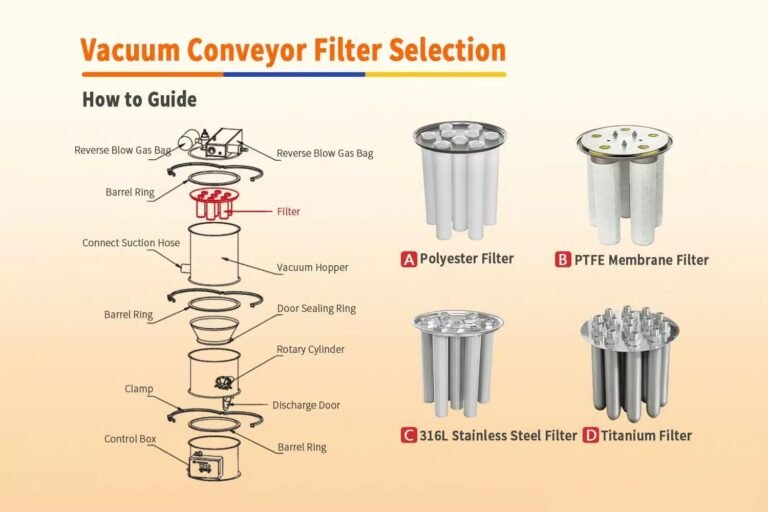
- Automated lines: pair with a vacuum feeder for closed material transfer, reducing manual contact and dust
Recommended Configurations by Application
Reference table for common food powder scenarios:
| Application | Pack Size | Recommended Hopper | Screw Type | Drive | Hygiene Grade |
|---|---|---|---|---|---|
| Cocoa / coffee powder | 100g–1kg | 30L | Wide-pitch shallow-flute single-start | Servo | Food-grade 304 |
| Milk / protein powder | 200g–2kg | 30L / 50L | Double-start precision | Servo | Food-grade 304 / 316L |
| Flour / grain powder | 1kg–5kg | 50L | General-purpose single-start | Servo / VFD | Food-grade 304 |
| Spices / seasonings | 10g–500g | 30L | Narrow-pitch precision single-start | Servo | Food-grade 304, quick-release |
| Food additives | 5g–100g | 30L | Micro-dose precision | Servo | 316L, GMP sanitary design |
Common Selection Pitfalls
1. Inflated accuracy claims
Many suppliers advertise ±0.2% accuracy — but that is ideal laboratory data. In real production, affected by material density and humidity, consistent ±0.5% is already excellent. Always test with your own material, at your actual pack size, across 20+ consecutive fills.
2. Material downgrades
Suppliers may say 304 stainless steel but deliver 201 or lower grade, which rusts over time and contaminates product. Always write the contact-material specification into the contract, and verify upon delivery if needed.
3. Fake quick-release
It looks dismantlable, but requires special tools, takes hours, and has too many screws and gaps that trap powder. Always request a real disassembly video before ordering, and confirm it is truly tool-less.
4. Non-standard wearing parts
Seals, bearings and other wear parts use non-standard sizes, forcing you to buy only from the original supplier at high prices and long lead times. Ask for wear part specifications up front and confirm they are standard, off-the-shelf components.
5. Machine-only sales, no system solution
You buy the main unit, only to find it does not match your existing feeder, sealer or conveyor, and end up engineering costly modifications. Prefer suppliers who can deliver complete line solutions — it saves many headaches.
Real Project Case: Protein Powder Filling Accuracy Upgrade
Client Background
A sports nutrition protein powder manufacturer in Guangdong, China. They previously ran 2 standard VFD screw fillers with 8 operators across two shifts, filling 500g cans. Core pain points: filling error fluctuated above ±1.5%, causing high material waste; product changeover and cleaning took 3 hours per flavor, slowing new product launches; GMP audit failed on cleaning validation.
Core Requirements
- Hold filling error consistently within ±0.5% to reduce material waste
- Reduce changeover and cleaning time to under 1 hour for multi-flavor small-batch production
- Meet GMP hygiene standards and pass cleaning validation
- Increase single-shift output from 8,000 to 12,000+ cans
Our Solution
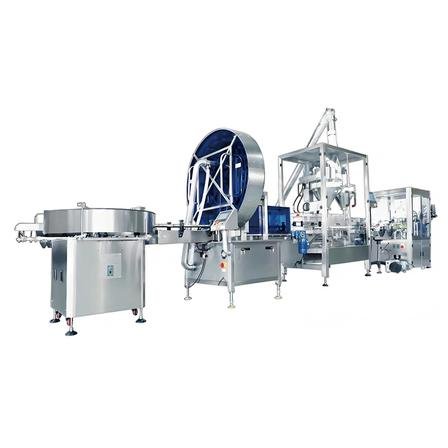
Replaced with 2 units of 30L servo-driven screw metering machines, paired with vacuum feeders and integrated with the existing can filling line. Custom modifications:
- All product-contact parts in 316L stainless steel, mirror-polished welds, no dead corners
- Tool-less quick-release screw design with food-grade silicone seals (standard parts)
- Servo drive with density compensation function to handle batch-to-batch density variation
- Integrated dust extraction port on hopper, connected to plant dust collection system
Results
- Accuracy: Filling error stabilized at ±0.3% to ±0.4%. Material waste dropped from 1.8% to 0.4%, saving approximately ¥320,000 per year in raw material costs.
- Output: Single-shift production stabilized at 13,500 cans — a 69% increase.
- Changeover: Single-product cleaning and changeover reduced from 3 hours to 45 minutes — 300% faster flavor switching.
- Compliance: Passed GMP audit on first attempt; cleaning validation fully approved.
Client Feedback
“We wasted money on two previous machines that never delivered consistent accuracy, and we had to rework for GMP twice. With these new units, we have passed every weight check. The material savings alone will pay for the machines in about half a year. The quick-release design is a huge time saver — no more overtime tearing down machines for flavor changes.” — Production Manager Li (discretionary)
Frequently Asked Questions
What is the real accuracy of a 30L screw metering machine?
For standard food powder with servo drive, real production accuracy is consistently ±0.3% to ±0.5%. With very uniform material, best case can reach ±0.2%. Exact performance depends on material properties and pack size — we recommend sending samples for a live test.
Do I have to change the screw when switching between different powders?
It depends on the difference. For similar powders with close density, parameter adjustment is usually enough. If switching from fine powder to granular powder, or if density and flow properties differ significantly, we recommend changing to a matched screw for best accuracy and speed.
Can a screw metering machine pass GMP audit?
Yes — but only the GMP sanitary configuration: full 304/316L contact material, mirror-polished welds, no powder-trapping dead corners, and tool-less cleanable design. Standard industrial-grade machines will not pass; the detail differences are significant.
How often should screws and seals be replaced?
Under normal production conditions, auger screws last 3–5 years. Food-grade silicone seals should be replaced every 3–6 months, depending on material abrasiveness and operating hours. Regular replacement of wear parts maintains consistent accuracy.
Summary
The core logic for selecting a screw metering machine is: match screw design to your material first, then size hopper capacity to your output and pack size, and finally set hygiene specification to your compliance requirements.
Do not compare on price alone. Low-cost machines almost always cut corners on material, accuracy and after-sales support — and retrofitting later costs far more.
For an overview of the full powder packaging workflow, see our previous article How Does a Food Powder Packaging Machine Work?. In our next article, we cover Accuracy Tuning and Preventive Maintenance for Screw Metering Machines, to help you keep your equipment running at peak performance.
Uniflow Packaging Machinery | Specialists in food-grade powder filling and packaging equipment. We offer material testing trials and custom engineered solutions. For sizing support or a line upgrade assessment, contact our engineering team for a free evaluation and quotation.