Your powder feeder is the bottleneck of your entire line. Choose well, and production runs clean and uninterrupted. Choose poorly, and you’ll deal with clogged lines, hidden residue, and cleaning sessions that eat up half a shift.
Here’s the practical comparison — and the one structural upgrade that solves the biggest complaint about screw feeders.
Vacuum Feeder
Uses compressed air to pull powder through a fully sealed tube.
Pros:
- First, completely dust-free — ideal for food, pharma, and clean rooms.
- Fast to clean; fewer internal parts
- Flexible layout; works in tight spaces and over long distances
Cons:
- However, it struggles with sticky, damp, or very dense powders.
- Higher upfront cost
Screw Feeder
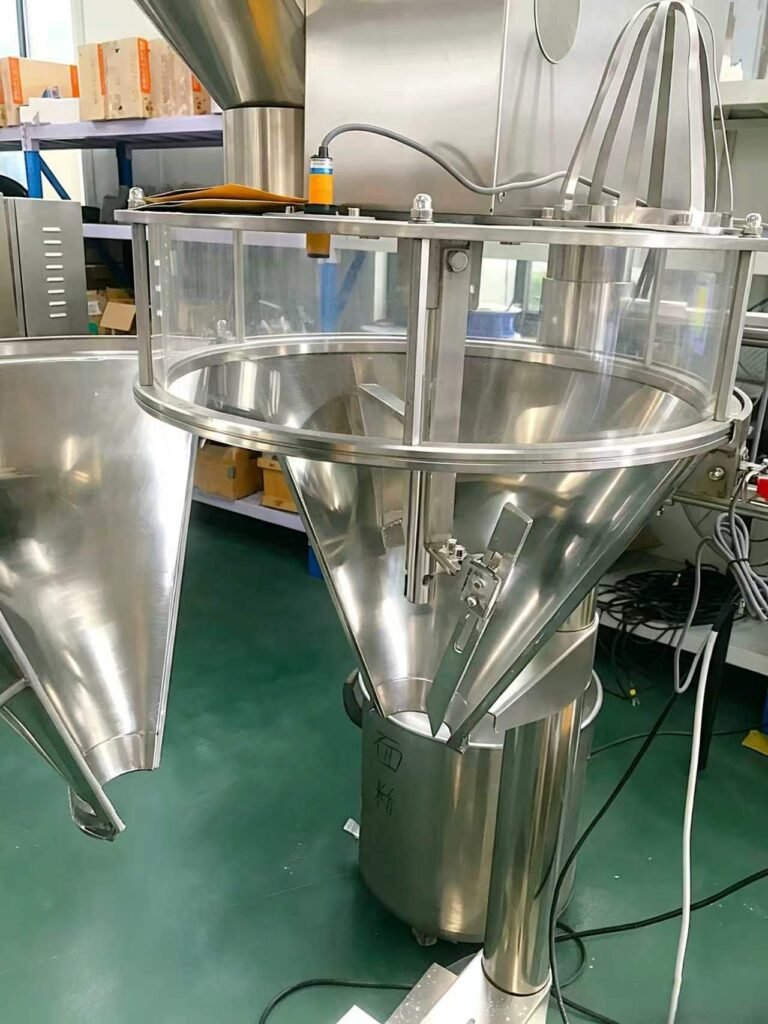
Uses a rotating auger inside a tube to mechanically push powder forward.
Pros:
- High throughput, continuous duty
- Handles almost any powder or granule
- Lower purchase price
Cons:
- Cleaning is painful. A welded closed tube means hidden residue behind the auger, full disassembly required, and 2–4 hours per changeover.
The Upgrade That Fixes Screw Feeder Cleaning: Open-Door Design
Instead of a permanently welded tube, the open-door screw feeder uses a split tube with quick-release clamps. Release the clamps, lift the lid, and the entire auger and interior are fully exposed.
What changes:
- Cleaning drops from hours to minutes — no disassembly needed
- Every surface is visible — no guessing about leftover residue
- Cross-contamination risk between batches is dramatically reduced
- All the throughput and durability of a screw feeder, with none of the cleaning penalty
For plants running multiple products, this is the single highest-ROI upgrade you can make.
Materials That Matter
| Component | Standard | Upgrade |
|---|---|---|
| Screw feeder body | 304 stainless — most food & chemical use | 316L stainless — acidic, salty, or pharma products |
| Vacuum feeder filter | PE sintered — cost-effective for standard powders | Titanium sintered — lasts years, easy to back-clean, for pharma & fine chemicals |
Rule of thumb: if your product contains salt or acid, use 316L. If filter downtime is expensive, use titanium.
Which One Do You Need?
| Vacuum Feeder | Traditional Screw Feeder | Open-Door Screw Feeder | |
|---|---|---|---|
| Throughput | Medium | High | High |
| Dust control | Excellent | Good | Good |
| Cleaning speed | Easy | Very slow | Fast |
| Best for | Clean rooms, pharma, fine powders, limited space | Single-product high-volume lines | High-volume lines with frequent changeovers |
As a result, your decision comes down to three simple scenarios:
Pick a vacuum feeder if dust control and hygiene are your top priority and your powders flow freely.
Go with a traditional screw feeder if you run one product, rarely clean, and want the lowest cost.
Choose an open-door screw feeder if you need high throughput and frequent product switches — this is the option that eliminates the cleaning bottleneck.
The Bottom Line
Ultimately,The right feeder depends on your product, your changeover frequency, and your hygiene standards. But if long cleaning times are currently costing you production hours, the open-door design is the most practical fix available today.