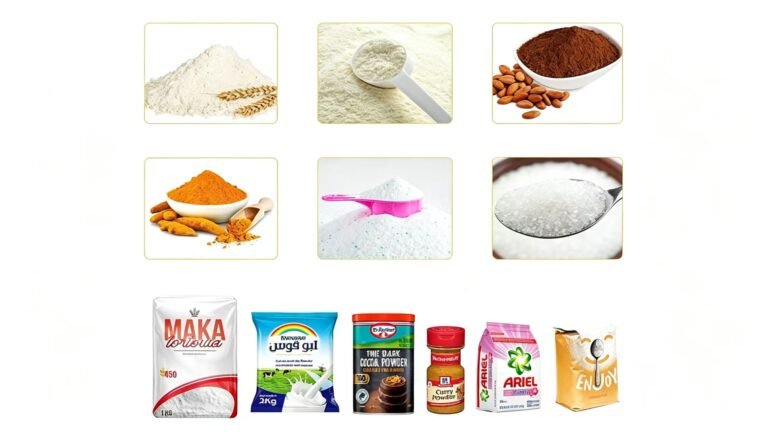
For manufacturers producing cookie, pancake and muffin pre-mixes, mixing consistency directly defines product quality, flavor uniformity and stability. When a formula combines bulk ingredients like flour, whey protein, sugar and salt with trace components such as baking powder, flavoring and sucralose, choosing the wrong mixer often leads to uneven dispersion, batch-to-batch variation and low production efficiency.
针对 200kg 级别的烘焙预拌粉批量生产,本文结合物料特性对比两款主流粉体混合设备,给出清晰的选型建议。
Key Mixing Challenges for Baking Pre-Mixes
The formula structure of baking pre-mixes sets specific requirements for mixing equipment:
- Wide variation in material properties: Flour, whey protein, sugar and salt differ greatly in density and particle size. Basic mixing often causes segregation and fails to achieve homogeneity.
- Low-dose trace ingredients: Ingredients like sucralose, flavoring and baking powder are added in very small quantities. When added directly to bulk materials, they rarely disperse evenly, resulting in inconsistent taste and sweetness from batch to batch.
- Balance of quality and output for mass production: For 200kg batch production, mixing uniformity, short cycle time and smooth discharge are all required to integrate with downstream screening and packaging processes.
Ribbon Blender vs V-Type Mixer: Which to Choose?
Top Recommendation: Ribbon Blender
For 200kg batch baking mix production, the ribbon blender is the most cost-effective first choice, especially for formulas combining bulk powders with trace additives.
Core advantages:
- Strong material adaptability: It achieves uniform, non-segregating mixing of powders with different densities and particle sizes, including flour, whey protein, sugar and salt, through convective and shear mixing action.
- Flexible working volume for production: It supports a wide filling range and fits 200kg batch production perfectly for commercial scale manufacturing.
- High mixing efficiency: Compared with V-type mixers, ribbon blenders deliver shorter batch cycles and higher hourly output.
- Smooth discharge for line integration: Bottom discharge design enables fast, clean unloading, and can be directly connected to conveying, screening and packaging equipment for full line production.
- Scalable for future growth: When production increases, the ribbon blending process can be easily scaled up to larger industrial machines with proven parameters.
When to Choose a V-Type Mixer?
V-type mixers can also be used for baking pre-mixes, but they are more suitable for special scenarios where ultra-gentle mixing is required and particle breakage must be avoided.
We do not recommend it as the first choice for standard baking mix formulas for the following reasons:
- Low effective filling ratio. For the same machine volume, actual batch output is much lower than a ribbon blender.
- For formulas with large amounts of base material and very small amounts of additives, both mixing uniformity and efficiency are inferior to ribbon blenders.
- It works better for small-batch, multi-SKU production, and is less cost-effective for 200kg volume mass production.
Critical Tip for Trace Ingredients Like Sucralose
If your formula contains very low-dose ingredients like sucralose, dispersion uniformity becomes the core quality control point.
We do not recommend adding trace ingredients directly into a 200kg bulk batch, as this easily causes local agglomeration and uneven distribution. The recommended process is: Premix first → then add to main blender First pre-mix trace ingredients such as sucralose and flavoring with a small portion of flour or sugar to make a masterbatch. Then add the masterbatch into the ribbon blender for final mixing with bulk ingredients. This method ensures even distribution of trace components throughout the whole batch and eliminates quality variation between batches.
Final Selection Advice
- For 200kg batch production of cookie, pancake and muffin baking mixes, prioritize a ribbon blender for the best balance of uniformity, efficiency and production line integration.
- Choose a V-type mixer only if your materials are extremely shear-sensitive and require intact particle structure.
- No matter which equipment you choose, always use a pre-mixing process for trace additives to guarantee consistent product quality.
If your baking mix production line is suffering from uneven mixing or batch-to-batch variation, or you need a custom mixing solution for your specific formula, feel free to contact our technical team. We will provide targeted recommendations based on your material properties and production requirements.